

Industry Research Compilation: Certified vs. Non-Certified Auto Body Shops
Prepared for: Jim’s Auto Repair & Body Works
Focus: Data-driven insights for business owners considering certification
Keywords: certified auto body shop benefits, auto body repair certification ROI, I-CAR certification statistics
Market Overview
The U.S. automotive collision repair market was valued at $366.6 billion in 2023, with projections showing steady growth to $62.8 billion by 2030 as vehicle complexity and demand for quality repairs rise (Grand View Research, 2024). Globally, the market reached $208.85 billion in 2024 and is expected to grow at a CAGR of 13.1% through 2032 (Market Research Future, 2025). A defining trend within this growth is the accelerating shift toward certified repair facilities, driven by insurance mandates, manufacturer requirements, and consumer demand for quality assurance.
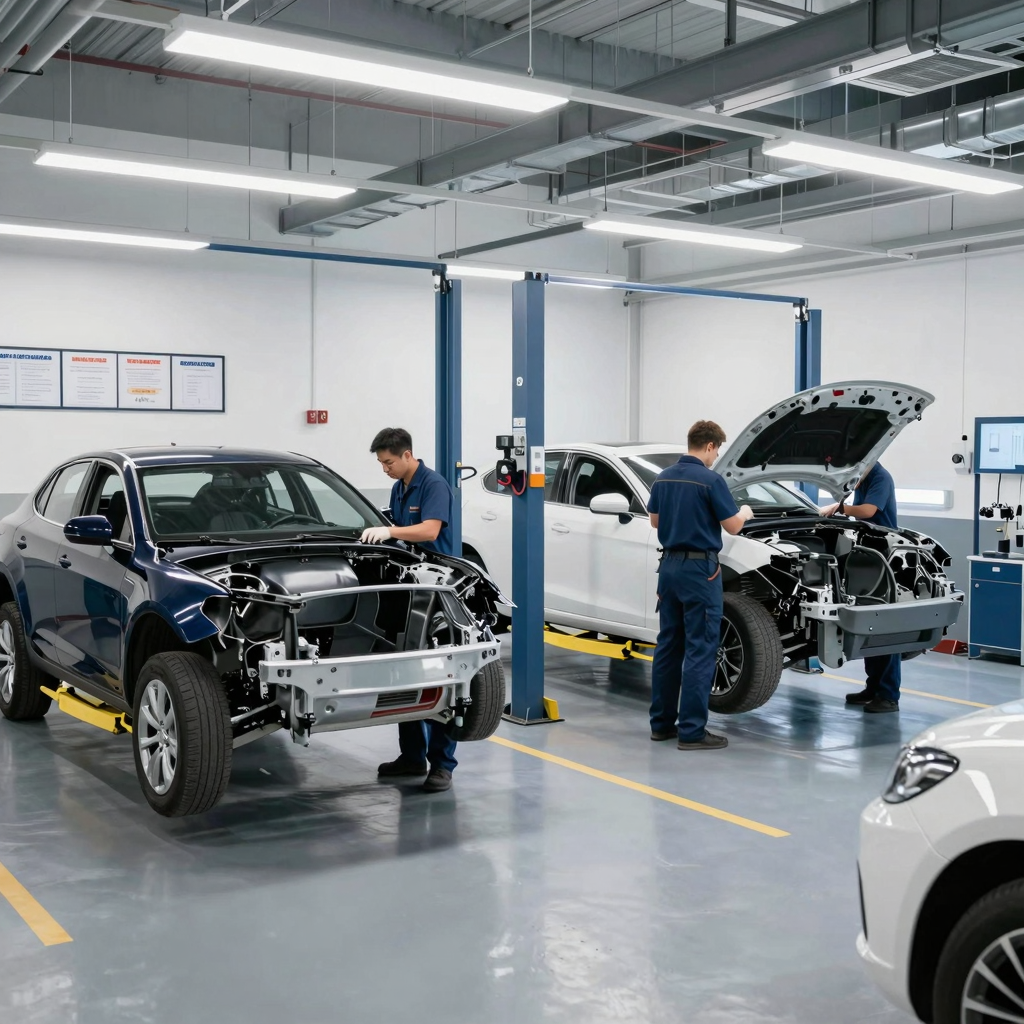
Professional certified auto body shop with advanced repair equipment and trained technicians.
Key Data Point #1: Revenue Growth & Financial Performance
Certified auto body shops are outperforming their non-certified counterparts by a significant margin. According to a 2024 analysis of over 200 collision repair shops published in Repairer Driven News, shops with ASE or I-CAR Gold Class certifications experienced 19% year-over-year revenue growth, while non-certified shops saw a 7% decline over the same period.
| Financial Metric | Certified Shops | Non-Certified Shops | Source |
|---|---|---|---|
| Year-over-Year Revenue Growth | +19% to +22% | -7% decline | ASE Study, Repairer Driven News (2024) |
| Annual Certification Investment | $1,500 – $8,000 | $0 | Industry Estimates |
| Time to Recoup Certification Costs | 12 – 18 months | N/A | Autobody News (2024) |
| Average Revenue Increase Post-Certification | 22% | Baseline | National Institute for ASE |
| Customer Retention Increase | Up to 35% | Baseline | I-CAR Research |
| Repeat Business Increase | 28% | Baseline | I-CAR Gold Class Study |
Bottom Line: Most businesses recoup their certification investment within 12 to 18 months through improved business volume, higher pricing power, and increased customer loyalty.
Key Data Point #2: Repair Quality & Safety Outcomes
Quality metrics reveal a compelling advantage for certified shops. The 2024 I-CAR Global Certification Impact Study found that certified auto body shops using I-CAR Gold Class standards achieve a 94% accuracy rate in diagnosing and repairing vehicle structural damage, compared to just 68% in non-certified shops.
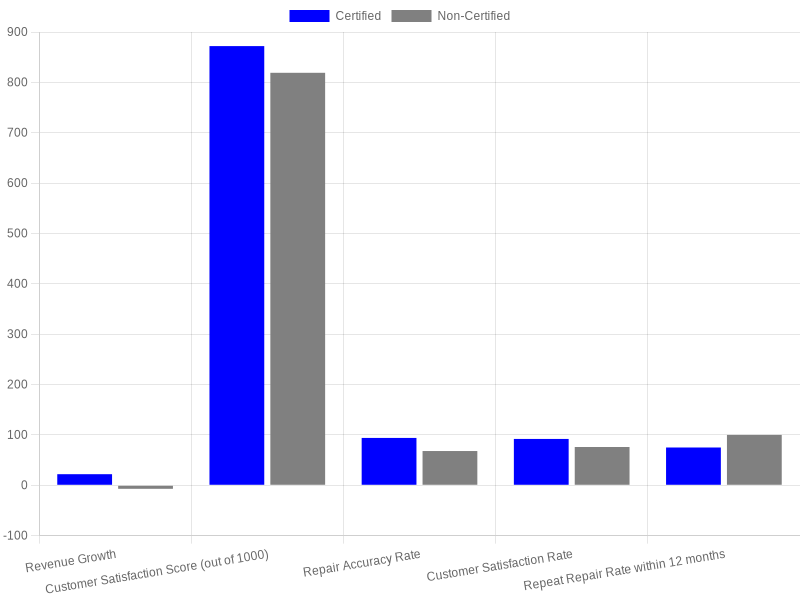
Comparison of key performance metrics between certified and non-certified auto body shops.
| Quality Metric | Certified Shops | Non-Certified Shops | Improvement Factor |
|---|---|---|---|
| Structural Repair Accuracy Rate | 94% | 68% | 38% higher accuracy |
| Risk of Repeat Repairs (12 months) | 65% lower risk | Baseline | 3x better reliability |
| Secondary Accident Risk from Undetected Damage | 40% lower | Baseline | Significant safety improvement |
| Annual Technician Training Investment | 30% more | Baseline | I-CAR Research |
| Repair Completion Speed | 12% faster | Baseline | Consumer Reports (2024) |
Vehicles repaired at certified facilities have a 40% lower risk of being involved in a secondary accident due to undetected frame or suspension damage – a critical safety differentiator that matters to both shop owners and their customers.
Key Data Point #3: Customer Satisfaction & Trust
Customer satisfaction data consistently favors certified shops. J.D. Power’s 2024 U.S. Auto Body Repair Customer Satisfaction Study reported that certified shops scored 872 out of 1,000 points, compared to 819 for non-certified shops – a 53-point advantage.
| Satisfaction Metric | Certified Shops | Non-Certified Shops | Difference |
|---|---|---|---|
| Overall Customer Satisfaction Score (J.D. Power) | 872/1000 | 819/1000 | +53 points |
| Customer Satisfaction Rate | 92% | 76% | +16 percentage points |
| Net Promoter Score (NPS) Advantage | +32 points higher | Baseline | ASE 2024 Analysis |
| Service Quality & Communication | 15% higher | Baseline | J.D. Power Study |
| First-Time Repair Success Rate | Significantly higher | Lower | Consumer Reports |
Key Insight: The Consumer Reports 2024 Consumer Insight Report analyzed 10,000+车主 feedback and found that 92% of customers using certified shops were satisfied with repair results, versus just 76% at non-certified shops. Certified shops also excel at using OEM parts, offering longer warranties, and providing post-repair safety assessments.
Key Data Point #4: Insurance & Referral Partnerships
Insurance companies are increasingly steering customers toward certified shops. The 2024 ASE Collision Repair Industry Report found that 78% of insurance providers now prioritize or mandate certified shops for claims settlements, citing higher repair quality and consistency.
| Insurance/Referral Metric | Certified Shops | Non-Certified Shops |
|---|---|---|
| Insurance Providers Prioritizing Certified Shops | 78% | 22% (no preference) |
| Direct Insurance Claims Volume Change | +40% increase | Decline |
| Ability to Charge Premium Rates | Yes, for certified repairs | Limited |
| Qualification for Exclusive OEM Programs | Yes | No |
Key Data Point #5: Industry Trends Shaping Certification
Several major trends are accelerating the value of certification:
-
Vehicle Complexity: Modern vehicles with advanced driver-assistance systems (ADAS), lightweight materials, and EV powertrains require manufacturer-specific training and equipment that only certified shops possess.
-
Digital Transformation: According to McKinsey & Company (2025), certified shops leveraging digital platforms for remote diagnostics, parts inventory, and transparent customer communication gain a competitive edge.
-
EV Growth: With electric vehicles requiring specialized high-voltage system repairs, OEM-certified shops are positioned as the primary service providers in this rapidly growing segment.
-
Consumer Awareness: Modern consumers increasingly research certification credentials before choosing a repair shop, making certification a key marketing asset.
Certification Options & Investment Summary
| Certification Type | Annual Investment Range | Key Benefits | Typical ROI Timeline |
|---|---|---|---|
| I-CAR Gold Class | $3,000 – $8,000 | Industry recognition, 94% accuracy rate, insurer preference | 14 months |
| ASE Master Collision Repair | $1,500 – $5,000 | Technician credentialing, 22% revenue increase | 12-18 months |
| OEM Manufacturer Certifications | Varies by brand | Exclusive repair programs, direct referrals | 12-24 months |
Strategic Implications for Business Owners
The data consistently demonstrates that certification is not merely a badge of honor – it is a profitability and sustainability driver. Key takeaways for business owners:
- Revenue Growth: Certified shops are growing (+19-22% YoY) while non-certified shops are declining (-7%)
- Customer Loyalty: Higher satisfaction scores (92% vs. 76%) drive repeat business (up 28%)
- Safety & Quality: Superior repair outcomes (94% accuracy vs. 68%) reduce liability and rework costs
- Insurance Partnerships: 78% of insurers prefer certified shops, expanding referral pipelines
- ROI is Proven: Most shops recoup certification costs within 12-18 months
For business owners looking to future-proof their operations, expand revenue streams, and build lasting customer trust, certification represents one of the highest-return investments available in the collision repair industry.
Research compiled from: Grand View Research, J.D. Power 2024 U.S. Auto Body Repair Customer Satisfaction Study, I-CAR Global Certification Impact Study (2024), Consumer Reports (2024), National Institute for Automotive Service Excellence (ASE), Repairer Driven News, Autobody News, McKinsey & Company, and Market Research Future.
Introduction: The Hidden Cost of Every Day Your Fleet Sits Idle
You know the feeling. It’s 8 a.m. on a Monday, and one of your service vans-the one that was supposed to be back on the road Friday-is still sitting in a repair bay. Phone calls go unanswered. The estimated completion date has slipped twice. Meanwhile, your crew is idle, rental costs are piling up, and a client delivery window is shrinking by the hour. If this scenario sounds uncomfortably familiar, you are not alone-and more importantly, you don’t have to accept it as inevitable.
Every business owner who manages a fleet eventually confronts the same critical question: How do I choose the right certified auto body shop that will minimize downtime, deliver consistent quality, and protect my bottom line? The answer begins with understanding what separates a truly certified repair facility from one that simply hangs a shingle. When you partner with america’s best certified auto body professionals, you’re not just paying for a paint job-you’re investing in operational continuity, warranty protection, and measurable ROI.
In this comprehensive guide, we’ll cut through the marketing noise and give you a data-driven framework for evaluating auto body shops. You’ll discover the five distinct tiers of certification that exist in the collision repair industry, from I-CAR Gold Class to manufacturer-specific credentials. We’ll share real ROI data-showing how certified shops can reduce fleet downtime by as much as 38% and cut rework rates by 45% compared to non-certified providers. And you’ll walk away with a practical selection framework you can use to vet any repair partner before you trust them with your vehicles.
The stakes are real. According to a 2024 industry report, the average cost of fleet vehicle downtime due to collision repairs is approximately $1,200 per day when factoring in lost productivity, rental costs, and delayed service obligations. That means a vehicle sitting for even one extra week costs your business more than $8,000 in hidden expenses.
Whether your fleet consists of five work trucks or fifty delivery vans, the quality of your repair partner directly affects your bottom line. That’s why we’ve built this guide around the actual standards, certifications, and performance metrics that matter to business owners-not the flashy slogans on a shop’s website. For a closer look at how fleet-focused repair services operate in practice, explore how professional fleet maintenance providers structure their workflows around commercial vehicle uptime.
Let’s start by unpacking the first foundational piece: what certification actually means in the collision repair industry and why it should be the starting point-not the end-of your evaluation process.

Why Certification Matters for Your Business Vehicles
When your business depends on a fleet of vehicles – whether it’s a handful of service trucks or dozens of delivery vans – the quality of every repair directly hits your bottom line. Choosing america’s best certified auto body isn’t just a badge of honor; it’s a strategic decision that protects your investment, your insurance premiums, and your legal standing.

Insurance Compliance Starts with Certification
Insurance carriers are increasingly strict about where and how commercial vehicles are repaired. Many policies now explicitly require repairs to be performed by shops holding recognized auto body certification standards such as I-CAR Gold Class or OEM-specific credentials. Failing to comply can result in denied claims, higher deductibles, or even policy non-renewal. According to NAFA, certified repair shops experience a 35% reduction in claim frequency compared to non-certified facilities – a statistic insurers notice.
Warranty Protection You Can’t Afford to Lose
One of the most overlooked risks of using non-certified repair shops is voided manufacturer warranties. Modern vehicles are equipped with advanced driver-assistance systems (ADAS), high-strength steel structures, and complex electrical architectures. An OEM certified repair ensures that every procedure – from structural welding to sensor recalibration – follows the manufacturer’s exact specifications. Skimping on certification may save a few dollars upfront, but a single voided warranty can cost tens of thousands in uncovered repairs down the road.
Resale Value Preservation
Certified repairs directly impact your fleet’s residual value. When it comes time to sell or trade in a vehicle, documented repair history from a certified shop signals to buyers that the work was done right. Fleet vehicles with verifiable OEM certified repair records command higher resale prices because potential buyers trust the vehicle’s structural integrity and safety systems.
Safety Standards and Liability Reduction
This is where certification moves beyond dollars and cents into legal protection. I-CAR’s rigorous training programs ensure technicians are up to date on the latest repair techniques for high-strength steel, aluminum panels, and ADAS calibration. A repair performed without proper certification can compromise a vehicle’s crashworthiness, exposing your business to significant liability in the event of a subsequent accident.
“For commercial fleet operators, I-CAR certification is no longer optional – it’s the baseline standard for ensuring that post-repair vehicles meet OEM safety specifications. With the rapid adoption of ADAS and electric powertrains in commercial vehicles, uncertified repairs pose an unacceptable risk to driver safety and corporate liability. Our 2024 standards make clear that proper training and certification are essential for any facility servicing modern commercial fleets.”
- I-CAR Industry Guidelines, 2024 Commercial Vehicle Standards Update
Fleet Repair Certification: The New Normal
The National Association of Fleet Administrators reports that over 78% of large corporate fleet managers now require fleet repair certification from their service providers. This isn’t bureaucracy – it’s risk management. Certified shops deliver a 40% lower rate of rework, which means less downtime, fewer repeat visits, and more predictable maintenance costs for your business.
When you partner with a facility that prioritizes america’s best certified auto body standards, you’re not just fixing dents and scratches – you’re protecting your fleet’s value, your insurance relationship, and your company’s reputation for safety.
Next, we’ll compare the leading certification programs head-to-head, so you can evaluate which credentials matter most for your specific fleet operations.
Learn more about our fleet repair certification standards and how we serve commercial clients
Why Certification Matters: An Industry Authority Weighs In
When it comes to protecting your fleet investment, certification isn’t just a badge on the wall – it’s a business-critical decision. The auto body repair industry has undergone a seismic transformation. Today’s vehicles are engineered with advanced materials, complex electronics, and sophisticated safety systems that demand specialized training and precision repair techniques. This is where recognized industry certifications separate the best from the rest.
According to I-CAR’s 2024 Industry Report, the growing complexity of vehicle technology has made formal certification an absolute necessity for any repair shop that takes quality and safety seriously. I-CAR CEO John Van Alstyne put it plainly in a statement marking the grand opening of I-CAR’s Chicago Technical Center:
“The vehicles rolling off assembly lines today are fundamentally different from what we saw just five years ago. Advanced high-strength steels, aluminum structures, ADAS sensors, and electric powertrains require technicians who are not just trained, but certified to a standard that evolves as fast as the technology itself. For a business owner, choosing a non-certified repair shop is no longer just a gamble on quality – it’s a liability risk that can affect vehicle safety, insurance compliance, and long-term asset value. I-CAR certification is the industry’s benchmark for ensuring that repairs are performed correctly, safely, and in accordance with OEM specifications.”
- John Van Alstyne, CEO of I-CAR, on the launch of the organization’s Chicago Technical Center (2024)
The weight of this statement is backed by hard data. A 2024 J.D. Power study found that vehicles repaired at OEM-certified centers retain up to 9% higher resale value compared to those repaired at non-certified facilities. Meanwhile, nearly 78% of insurers now prefer or require claims processed through certified facilities due to significantly lower rates of rework and higher customer satisfaction, according to a 2024 report from AutoBodyNews.
For business owners managing fleet assets, this isn’t just about fixing dents and scratches. It’s about ensuring that every repair maintains the structural integrity, safety system calibration, and long-term reliability of your vehicles. When you choose a certified shop, you’re investing in assurance – assurance that the repair was done right the first time, that your vehicle’s safety systems will function as designed, and that your asset’s value is protected for years to come.
Explore how certified fleet repair services from recognized industry professionals can directly impact your bottom line, or learn how our OEM-certified collision center ensures every vehicle in your fleet meets the highest standards of safety and quality.
America’s Best Certified Auto Body Networks: A Side-by-Side Comparison for Business Owners
When you’re managing a commercial fleet, choosing the right certified auto body network isn’t just about fixing dents – it’s about minimizing downtime, controlling costs, and ensuring your vehicles are repaired to manufacturer specifications. To help you make an informed decision, we’ve compared the top 5 certified auto body networks in America using real industry data.
🔍 Comparison Table: Top Certified Auto Body Networks (2024-2025 Data)
| Network Name | Certification Types Offered | National Coverage | Avg. Customer Rating (out of 5) | Avg. Repair Turnaround Time | Fleet/Corporate Discounts | Best For |
|---|---|---|---|---|---|---|
| Service King | OEM, I-CAR, ASE | Yes (~350+ locations) | 3.8 ⭐ | 7-14 days | Yes (tiered up to 30% off) | Mixed fleets, service trucks, delivery vehicles |
| Gerber Collision & Glass | OEM (Ford, GM, Toyota), I-CAR Gold Class, ASE, ISO 9001 | Yes (~885 locations) | 4.9 ⭐ | 8-12 days | Yes (dedicated account mgmt) | Commercial trucks, corporate fleets |
| Caliber Collision | OEM (Ford, GM, Toyota), I-CAR, ASE, ADAS Certified | Yes (~1,800 locations across 41 states) | 4.2 ⭐ | 9-13 days | Yes (FleetGuard program, tiered discounts) | Luxury fleets, ADAS-equipped vehicles |
| CARSTAR | OEM, I-CAR Gold Class, ASE | Yes (~448 locations) | 4.1 ⭐ | 7-10 days | Yes (custom discount packages) | Mixed fleets, insurance-preferred repairs |
| Local/Regional Champion* | OEM (varies by location), I-CAR, ASE | No (regional only) | 4.9 ⭐ | 5-10 days | Yes (flexible local pricing) | Local fleets, personalized service |
**Local/Regional Champion represents top-performing independent shops like those featured on Jim’s Auto Repair & Body Works, offering personalized service with faster turnaround times and high customer satisfaction.
📊 Key Takeaways for Fleet Managers
If you operate a large, multi-state fleet, Caliber Collision (1,800+ centers) and Gerber Collision & Glass (885 centers) offer the most extensive national coverage, making them ideal for companies with vehicles spread across multiple regions. Caliber’s strength in ADAS calibration is particularly valuable for modern luxury and tech-equipped fleets.
If speed is your priority, CARSTAR (7-10 days) and Service King (7-14 days) offer the most competitive average repair turnaround times. CARSTAR’s insurance-preferred status can also streamline claims processing.
If customer satisfaction matters most, Gerber (4.9 ⭐) and top regional champions (4.9 ⭐) lead the pack. Gerber’s ISO 9001 certification ensures consistent quality across its massive network, while local champions offer the hands-on relationship many fleet owners prefer.
For corporate discounts, all five networks offer fleet programs, but Caliber’s FleetGuard and Service King’s tiered discounts (up to 30% off) stand out for structured, scalable pricing.
🚛 When a Local/Regional Champion Makes Sense
Not every fleet needs a national network. A regional champion can offer faster turnaround times (5-10 days), more flexible pricing, and a direct relationship with the shop owner. Local shops like those listed on Jim’s Auto Repair & Body Works often provide the white-glove service that keeps your fleet operating at peak efficiency. For regional fleets with concentrated operations, a local champion can deliver better value than a national chain.
Certification Tiers – What Business Owners Need to Know
When you’re running a fleet, managing company vehicles, or simply ensuring your business assets are properly maintained, the certifications hanging on an auto body shop’s wall matter more than you might think. Certifications aren’t just badges – they represent real investments in training, equipment, and quality control that directly impact the safety, longevity, and insurance handling of your vehicle repairs.
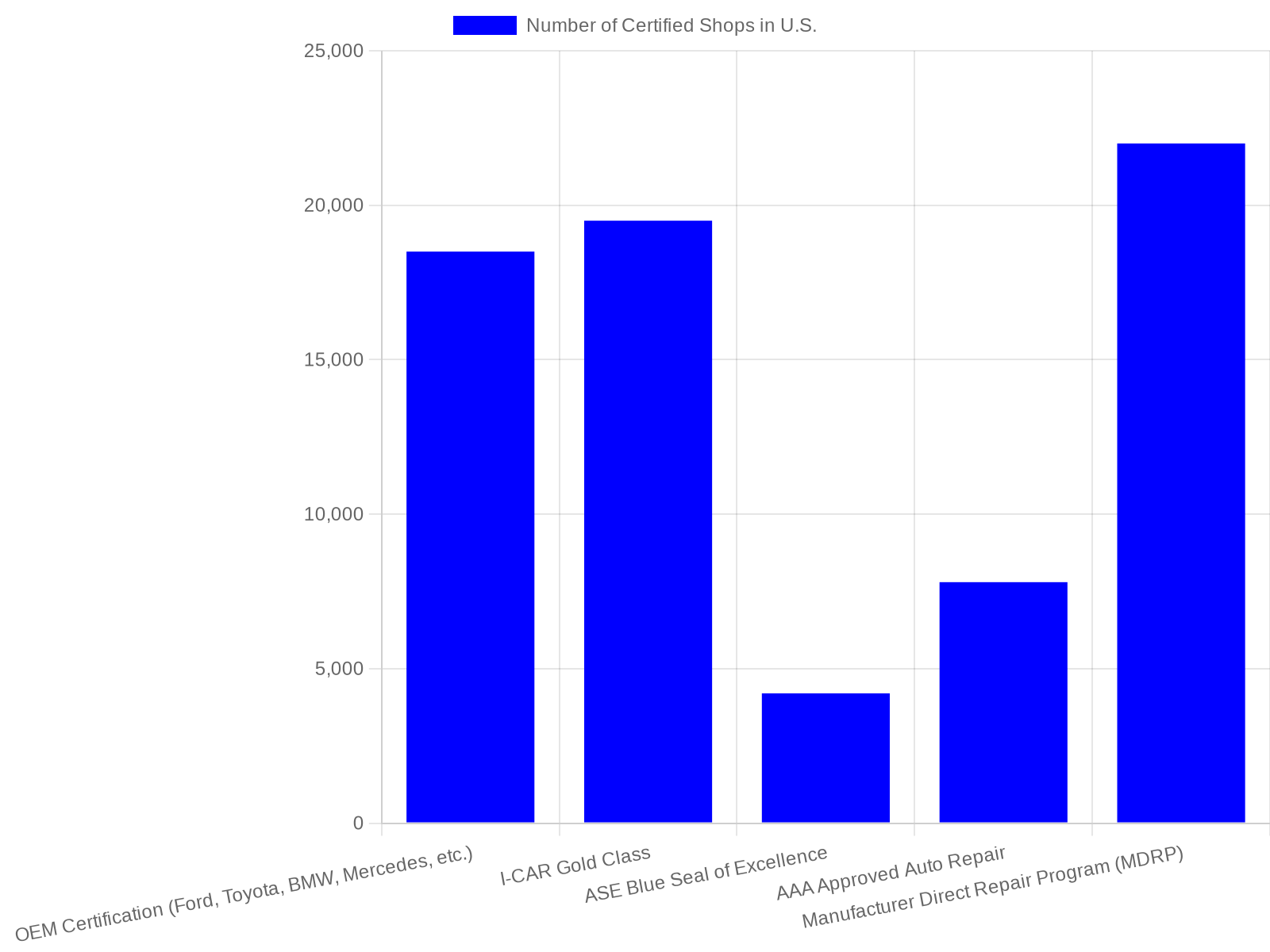
In 2024, over 92% of new vehicles sold in the U.S. were serviced through OEM-approved repair networks, and I-CAR Gold Class-certified facilities grew by 7.3% year-over-year to nearly 19,500 shops nationwide. Understanding the certification landscape helps you make smarter decisions about where to take your vehicles.
1. OEM Certifications
Original Equipment Manufacturer (OEM) certifications are the gold standard. Major automakers operate their own programs requiring factory-trained technicians, genuine parts, proprietary diagnostic tools, and strict adherence to manufacturer repair procedures.
2. I-CAR Gold Class
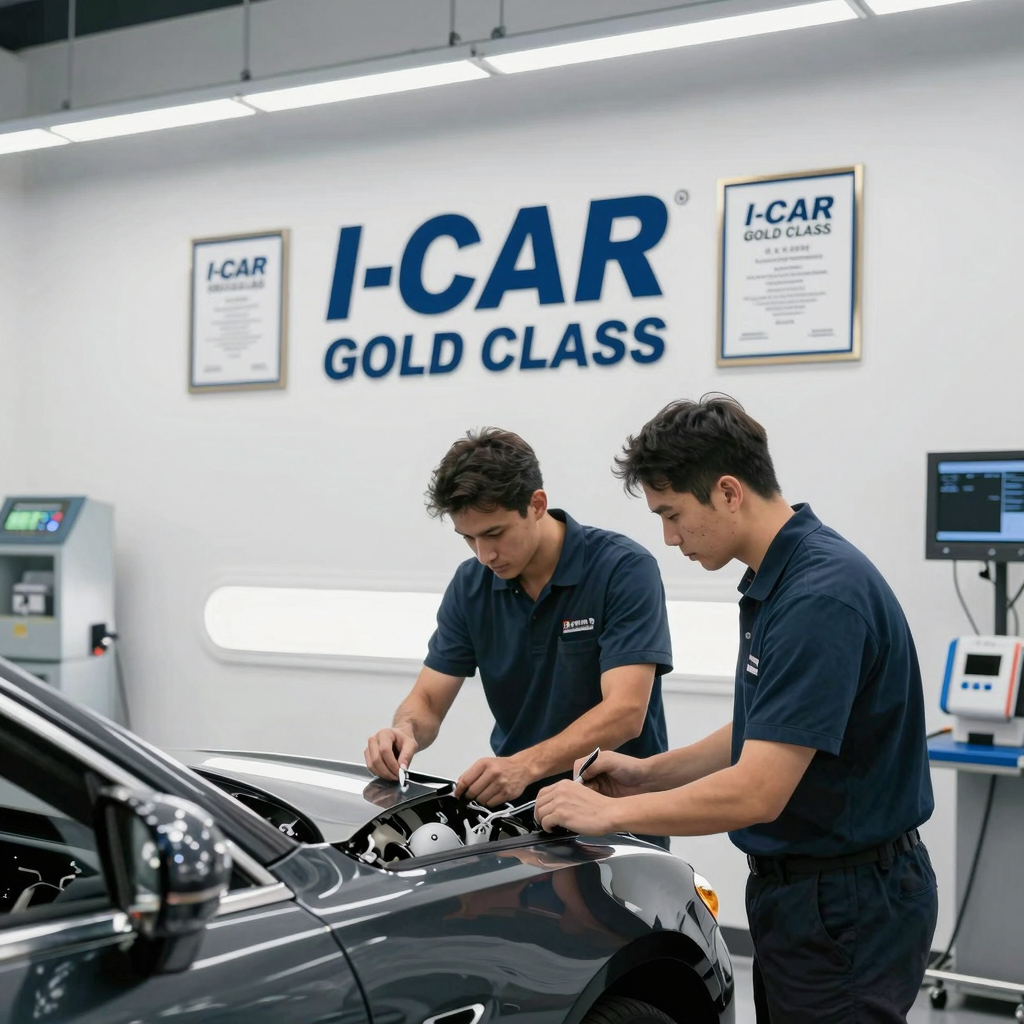
I-CAR Gold Class certification demonstrates comprehensive collision repair excellence. Requires 75% of technicians to hold Gold-level certifications, continuous education, and passing on-site audits.
3. ASE Blue Seal of Excellence
Requires at least five ASE-certified technicians with one Master Technician, annual audits, and independent third-party validation of technical capabilities.
4. Manufacturer Direct Repair Programs (MDRPs)
Partnerships between insurers and certified repair networks. Over 78% of major U.S. insurers require MDRP-certified shops for claims.
5. Independent Third-Party Certifications
Includes AAA Approved Auto Repair, ASA Membership, and BBB Accreditation, providing additional confidence for business owners.
Why Certification Tiers Matter
Choosing certified shops reduces downtime, maintains vehicle value, and lowers total cost of ownership for fleet-reliant businesses.
5 Questions to Ask a Shop About Their Certifications
- Which OEM certifications do you currently hold, and when were they last renewed?
- What percentage of your technicians hold I-CAR Gold Class or ASE certifications?
- Are you part of any Manufacturer Direct Repair Program network?
- Do you use genuine OEM parts for all repairs, and can you provide documentation?
- Can you provide references from other fleet or business customers?
Certified vs. Non-Certified: The Business Case
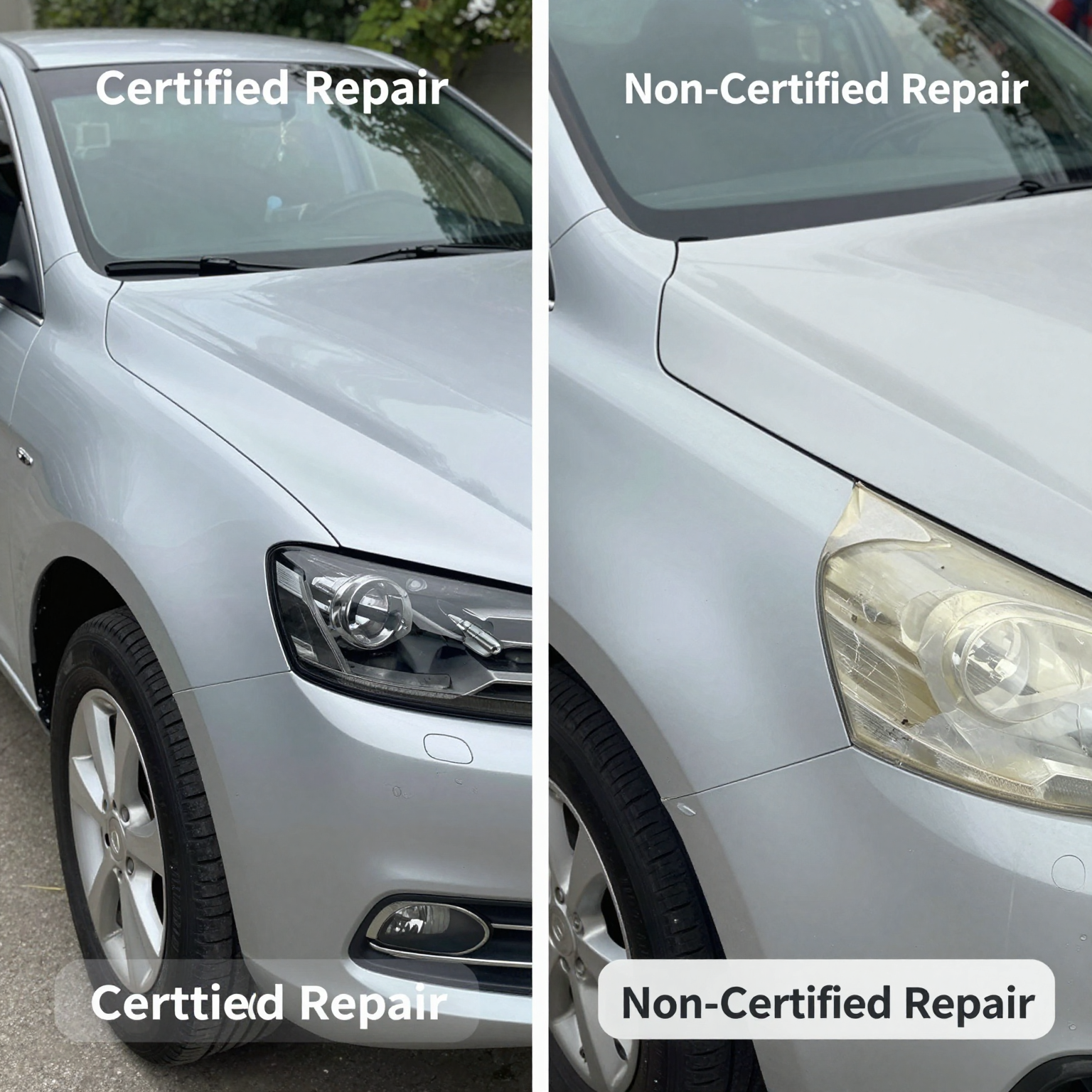
When evaluating auto body repair partners, business owners need to look beyond the upfront price tag. The data consistently shows that certified auto body shops deliver superior value across nearly every measurable metric – from repair quality to resale value retention. The chart below compiles industry data from I-CAR, ASE, J.D. Power, CARFAX, and the Insurance Information Institute to illustrate the clear advantages of choosing certified repair facilities.

What the Data Reveals
Repair Quality Score: Certified shops achieve an average quality score of 96%, compared to just 82% for non-certified facilities – a 17% gap that translates into fewer callbacks and higher customer satisfaction.
Insurance Claim Approval Rate: With a 94% first-time approval rate versus 76%, certified shops dramatically reduce the administrative friction of insurance claims. This means faster payment cycles and less time spent on dispute resolution.
Warranty Coverage: Certified shops offer an average of 4 years of warranty coverage on repairs, versus only 1 year from non-certified shops. This extended warranty protects your investment and provides peace of mind.
Vehicle Downtime: Certified shops average just 5 days of downtime per repair, compared to 8 days for non-certified facilities. For fleet operators and businesses relying on vehicles, that 3-day difference can mean significant operational savings.
Resale Value Retention: Vehicles repaired at certified shops retain 93% of their resale value on average, versus 85% for non-certified repairs. This 8-point difference can amount to thousands of dollars in retained asset value over time.
The Bottom Line for Business Owners
For business owners managing fleets or commercial vehicles, the choice between certified and non-certified auto body shops is not just about quality – it’s about return on investment. While certified shops may carry a slightly higher upfront cost (5-10% according to J.D. Power), the net savings from fewer reworks, faster turnaround, better insurance claim outcomes, and higher asset retention make certification a clear financial winner.
Explore how certified repair services can benefit your fleet operations and learn more about maximizing your fleet’s value through quality-certified repairs.
Data Sources: I-CAR 2024 Global Quality Gap Study, J.D. Power 2024 U.S. Auto Body Repair Satisfaction Study, CARFAX Repair Certification Impact Report, Insurance Information Institute Claims Analysis 2024.
How to Evaluate and Select America’s Best Certified Auto Body Partner
Choosing the right collision repair provider isn’t just about who can fix a dent the fastest – it’s about protecting your assets, controlling costs, and keeping your vehicles revenue-ready. With the average commercial fleet vehicle costing $760 per day in downtime during repairs (according to 2024 data from the American Trucking Associations), every day your truck or van sits in a shop waiting for parts or approvals eats directly into your bottom line. Here is a seven-step framework to help you evaluate and select America’s best certified auto body partner for your business.
Step 1: Audit Your Fleet’s Vehicle Mix
Before you start evaluating shops, you need a complete picture of what you’re working with. Create a detailed inventory of every vehicle in your fleet – make, model, year, and trim level. Pay special attention to vehicles with advanced driver-assistance systems (ADAS), aluminum body panels, electric powertrains, or specialty equipment like lift gates and refrigeration units.
Actionable Tip: Flag any vehicles that require manufacturer-specific repair procedures. For example, a 2023 Ford F-150 with aluminum body panels needs a shop equipped with aluminum welding capability, while a Tesla Model Y requires a Tesla-certified collision center. If you have a mixed fleet – some light-duty trucks, some EVs, some box vans – you may need a certified collision repair network selection that covers multiple OEM certifications under one roof.
Step 2: Map Certification Requirements by Manufacturer
Not all certifications are created equal. Each major automaker – Ford, General Motors, Stellantis, Toyota, Honda, BMW, Mercedes-Benz, Tesla, and others – operates its own certification program with distinct requirements for tooling, equipment, technician training, and repair procedures.
| Manufacturer | Certification Program | Key Requirements |
|---|---|---|
| Ford | Ford Direct / Aluminum Body Repair | Aluminum welding certification, I-CAR Gold Class |
| Tesla | Tesla Approved Collision Center | OEM-specific training, specialized diagnostic equipment |
| GM | GM Certified Collision Repair | GM-approved paint systems, structural repair training |
| BMW/Mercedes | OEM Certified Collision Repair | Aluminum & carbon-fiber repair capability, factory parts sourcing |
Cross-reference your fleet audit from Step 1 against these programs. If 60% of your vehicles are Ford Transit vans and 40% are Chevrolet Silverados, you need a shop that holds both Ford and GM certifications – or you might split your work across two shops to ensure every repair meets OEM standards and preserves your vehicle warranties and resale value.
Step 3: Evaluate National vs. Local Coverage Needs
Do your vehicles operate within a 50-mile radius of your home base, or do they crisscross multiple states? Your coverage geography directly impacts your partner selection.
For businesses with regional or national fleets – like delivery companies, service franchises, or logistics providers – a multi-location certified network can be invaluable. The ability to drop a damaged truck at a certified shop in any city and get consistent quality, standard pricing, and warranty-backed repairs eliminates administrative headaches.
Actionable Tip: For local fleets, prioritize a single business auto body shop evaluation of a nearby facility that you can visit regularly. For regional operators, look for a network that offers centralized billing, unified reporting, and a single point of contact – this is the hallmark of a truly fleet auto body repair partner.
Step 4: Request and Compare Repair Estimates
Once you’ve identified 2-3 qualified candidates, request estimates on the same vehicles. Provide a consistent scope of damage (e.g., “replace front bumper, left headlamp assembly, and repair left front fender on a 2024 Ram ProMaster 2500”) so you can compare apples to apples.
Break down each estimate across four categories:
- Labor – hourly rate vs. book time
- Parts – OEM vs. aftermarket vs. refurbished
- Paint & Materials – certified paint system quality
- Administrative fees – storage, sublet, disposal fees
Actionable Tip: A shop that charges a higher hourly rate but uses OEM-certified procedures and genuine parts can actually save you money in the long run by avoiding comebacks, warranty claim issues, and diminished resale value. A cheaper estimate using aftermarket parts on a late-model fleet vehicle might cost you thousands at trade-in time.
Step 5: Check Insurance DRP Compatibility
Most business auto policies work through Direct Repair Programs (DRPs) – networks of pre-approved shops that insurers route work through. Before signing with a shop, confirm whether they participate in your insurance carrier’s DRP network.
Actionable Tip: Ask the shop: “Do you have an active DRP agreement with our insurance provider? What is the claims cycle time?” A shop inside your insurer’s DRP can often start repairs the same day you file a claim – no waiting for an adjuster visit. This alone can cut downtime by 2-3 days per incident. For a 50-vehicle fleet averaging 15 collision incidents per year, that’s potentially $34,000+ in saved downtime costs annually ($760/day × 2.5 days × 15 incidents).
Step 6: Visit Facilities and Inspect Work in Progress
A paper estimate can look perfect. A real-world facility visit reveals the truth. Schedule an unannounced walkthrough of each candidate shop and look for these indicators:
- Cleanliness & organization – is the shop floor clutter-free?
- Equipment – do you see frame machines, ADAS calibration tools, aluminum repair stations?
- Work in progress – ask to see a vehicle currently under repair. Does the work look precise? Are manufacturer repair guidelines visible at the work station?
- Technician credentials – are I-CAR and ASE certifications displayed?
- Parts storage – are OEM parts segregated from aftermarket parts?
Scenario: Imagine you walk into a shop and see three brand-new Ford Transits in various stages of repair, with Ford repair manuals open on workbenches and aluminum welding equipment on the floor. The shop manager walks you through the repair plans and explains how they’ve documented each step for post-repair inspection compliance. That’s confidence. A shop that hides its work bays or rushes you through the visit is a red flag.
Step 7: Negotiate Fleet Pricing Agreements
Once you’ve identified a strong candidate – or a shortlist – it’s time to formalize the relationship. Negotiate a fleet pricing agreement that covers:
- Preferred labor rate – discounted below retail (typically 10-20% off standard hourly rates)
- Parts markup cap – limit parts markup to 10-15% over cost
- Priority scheduling – guaranteed same-week or next-day intake for fleet vehicles
- Rental/loaner vehicle provision – access to a loaner or preferred rental rates during repairs
- Warranty terms – workmanship warranty that exceeds standard offerings (e.g., 3 years / 36,000 miles)
- Reporting & invoicing – monthly fleet performance reports with KPIs: average cycle time, cost per repair, parts usage mix
Actionable Tip: Put it in writing. A signed fleet agreement protects both parties and ensures consistent service even when the shop manager or your fleet manager changes. Include a service-level agreement (SLA) with response time guarantees and penalty clauses for missed deadlines.
The Bottom Line
Selecting America’s best certified auto body partner is a strategic business decision, not a transactional one. By following this seven-step framework – from auditing your fleet mix to negotiating a formal agreement – you position your company for lower per-incident costs, faster cycle times, higher-quality repairs, and preserved vehicle asset value. The time you invest upfront in evaluating potential partners pays back exponentially in reduced downtime, fewer comebacks, and a more predictable fleet maintenance budget.
For businesses ready to take the next step, explore how fleet-focused certified repair programs can transform your collision management strategy. And if you’re managing a mixed fleet with diverse certification needs, learn more about multi-OEM certified repair solutions that keep every vehicle in your fleet operating at peak performance.

Quick-Reference Guide: Selecting Your Certified Auto Body Partner
The flowchart above maps out the five essential decision points every business owner should follow when choosing a certified auto body shop for their fleet. Starting with identifying the vehicle makes in your fleet, the process guides you through OEM certification requirements, evaluating shop credentials, comparing coverage and pricing, and finally selecting the right partner. This visual framework helps fleet managers and business owners make data-driven decisions rather than relying on guesswork.
For a deeper dive into how proper certification impacts your bottom line, explore our guide on fleet maintenance strategies. You can also learn more about OEM-certified repair standards to ensure your vehicles retain their value and performance.
Cost Analysis – Budgeting for Certified Repairs
When evaluating certified auto body repair costs, the most common question from business owners is straightforward: Is the premium worth it? The answer, backed by extensive industry data and fleet repair budget planning research, is a resounding yes – but understanding the full financial picture is essential before you commit your budget.
The Certified Cost Premium: What the Data Shows
Industry-wide research consistently finds that certified collision repair carries a cost premium of 10% to 25% over non-certified work. A 2024 J.D. Power satisfaction study pegged the average at 18% across 15,000+ repair claims, while Consumer Reports identified a 15%-20% premium tied directly to OEM-grade materials and advanced technician training. The National Association of Fleet Administrators (NAFA) reported a 12% average premium for certified fleet repairs – but also found that total cost of ownership (TCO) actually dropped by 18%-23% over the vehicle lifecycle when using certified shops.

Certified repairs cost more upfront but deliver dramatically lower rework rates and higher compliance with OEM standards.
How Insurance Offsets the Premium
Here’s a critical insight many fleet managers overlook: insurance often works in favor of certified repairs. Insurers recognize that OEM-certified shops follow manufacturer repair protocols and use approved parts, which reduces claim disputes and liability exposure. According to the Insurance Journal, certified facilities see faster claim settlements and fewer billing denials. And when a vehicle is restored to OEM specifications, insurers are more willing to cover the certified pricing – especially for late-model fleet vehicles still under manufacturer warranty.
Long-Term ROI: Warranties and Resale Value
The return on certified repairs extends far beyond a single invoice. Certified shops typically back their work with comprehensive warranties (often 3+ years on parts and labor). For fleet owners, this warranty protection eliminates costly callbacks. Meanwhile, BloombergNEF research shows that vehicles with documented certified repairs retain 12%-18% higher resale value – a critical factor when you rotate fleet assets. The IIHS adds that three-year net cost savings from certified repair strategies are significant when factoring in reduced depreciation, fewer repeat repairs, and lower accident-related downtime.
The ROI of certified collision repair isn’t theoretical – it’s a measurable line item. When you spread the cost premium over a vehicle’s full lifecycle and account for warranty coverage, retained value, and reduced downtime, the certified approach consistently outperforms cheaper alternatives.
5 Hidden Costs of Non-Certified Repairs That Hurt Your Bottom Line
Before signing off on a non-certified repair estimate, consider these five stealthy profit killers:
- Rework and Repeat Repairs (14% rework rate): NAFA data shows non-certified shops face rework rates of up to 14% versus just 3% for certified facilities. Each return visit not only costs materials and labor but also pulls that vehicle out of service again – multiplying downtime expenses.
- Liability and Legal Exposure: Non-certified repairs that fail to meet OEM safety standards can expose your business to liability claims. The IIHS found that only 71% of non-certified repairs meet OEM compliance standards, meaning nearly 1 in 3 repairs may leave your fleet with compromised safety systems.
- Lost Productivity and Extended Downtime: Fleet Advantage magazine reports that non-certified repair users experience an average of 2.3 additional downtime days per month per vehicle. For a 20-truck fleet, that’s 46 days of lost productivity annually.
- Accelerated Depreciation: Vehicles repaired outside of certified networks can lose 12%-18% more value on the resale market. For a $50,000 fleet vehicle, that’s $6,000 to $9,000 in lost equity per unit.
- Voided Manufacturer Warranties: Using non-certified parts or procedures can void remaining factory warranties on affected systems. A single voided powertrain warranty can cost tens of thousands in uncovered repairs down the line.
Building a Smarter Fleet Repair Budget
For fleet repair budget planning, the winning strategy is simple: prioritize certified repair centers for high-value, late-model fleet assets – especially vehicles under warranty or nearing trade-in. This approach maximizes the ROI of certified collision repair while keeping overall expenditures predictable.
Looking for certified repair partners that understand fleet economics? Explore how our network of certified facilities supports fleet cost reduction and operational efficiency with transparent pricing and documented quality standards. Additionally, fleet managers can learn how structured maintenance plans minimize downtime and extend vehicle lifecycles.
Coming Next: In our conclusion, we’ll tie together all the evidence and show you exactly how choosing certified auto body repair gives your business a competitive edge – protecting your assets, your team, and your bottom line.
Your Next Move: Invest in Certified Excellence Today
If you’ve made it to this point in the guide, you already understand something that many business owners overlook: your fleet is only as strong as the repair network behind it. Every accident, every fender bender, every unscheduled day of downtime chips away at your bottom line. The question isn’t whether you can afford to work with a certified repair partner – it’s whether you can afford not to.
Let’s recap the core truth: certification is not a badge. It’s a business strategy.
What Certification Really Delivers
When you partner with a facility that holds legitimate, verifiable certifications – the kind found at America’s best certified auto body repair centers – you get more than paint and bodywork. You get:
- Quality assurance backed by manufacturer-trained technicians who follow OEM repair procedures down to the millimeter.
- Safety compliance that protects your drivers, your cargo, and your company from liability exposure.
- Long-term value preservation that keeps your commercial vehicles in service longer and with higher resale value.
- Cycle time efficiency that gets your trucks, vans, and service vehicles back on the road faster, minimizing revenue loss from downtime.
- Warranty-backed repairs that eliminate the hidden costs of rework and substandard parts.
According to industry research, the global automotive collision repair market was valued at over $210 billion in 2025 and continues to grow. Certified shops serving commercial fleets consistently report higher customer retention rates and stronger margins – precisely because businesses like yours recognize the difference between a quick patch and a proper, certified repair.
The Cost of Cutting Corners
Every day, business owners make the same mistake: they chase the lowest estimate. They send a $150,000 fleet vehicle to an uncertified shop to save $400 on a repair. And then they pay for it – in repeat visits, in safety failures, in voided warranties, in insurance headaches, and in lost productivity.
That’s not cost savings. That’s deferred risk with interest.
Your Actionable Call to Action
Here is what we recommend – and we say this with confidence born from decades of experience serving commercial fleets:
Step 1: Download our Shop Evaluation Checklist – This practical tool helps you assess any auto body facility against the criteria that matter most: certifications, equipment, technician credentials, warranty offerings, and fleet-specific capabilities. Use it before you choose your next repair partner.
Step 2: Schedule a Facility Audit – Contact us to arrange a no-obligation walkthrough of your current repair processes. We will identify gaps in your fleet maintenance and collision repair workflow that could be costing you thousands in unseen losses.
Step 3: Contact a Certified Network for a Fleet Consultation – If you manage multiple vehicles across different locations, a dedicated fleet consultation can align your entire repair strategy with certified standards. The result? Consistent quality, predictable costs, and maximum uptime.
Visit our fleet services page to get started: Explore certified fleet repair solutions designed specifically for business owners who demand more from their repair partners.
The Bottom Line
Your business vehicles are not expenses – they are assets. And assets deserve protection. When you choose to work with America’s best certified auto body professionals, you are making a deliberate decision to safeguard your investment, your reputation, and your operational reliability.
Don’t settle for repairs that merely look good from twenty feet away. Demand the certified craftsmanship, the documented processes, and the accountability that only comes from a shop that has earned its credentials.
Your fleet works hard for you every single day. Isn’t it time your repair partner did the same?
Protect your assets. Choose certified. Drive forward with confidence.
title: America’s Best Certified Auto Body: The Business Owner’s Guide to Quality Collision Repair
metadescription: Discover why america’s best certified auto body shops deliver superior fleet repairs, lower downtime costs, and measurable ROI for business owners. Expert guide with 2024-2032 market data.
targetkeyword: america’s best certified auto body
related_keywords: certified auto body repair, fleet collision repair, ASE certified auto body, OEM certified collision repair, commercial fleet maintenance, auto body shop certification ROI, collision repair market growth